Tuesday, January 8, 2013

capitalism cause alienation

Marx had a theory that the way that capitalism work causes alienation, the feeling of being uses or no control.  Marx believe the work force experiences alienation because work work all day building something that they can't take home or isn't even their.  The produce they spent all day making they don't receive any benefit from and belongs to the boss that will most likely near see it. This process leave the employ unattached to his work feeling empty and unmotivated.  As for if someone made something on their free time they would feel more emotionally attached and more fulfilled

I find this articular moderately reliable because i just found it on the internet but it does have an author.
http://syzygyastro.hubpages.com/hub/Karl-Marx-and-his-Theory-of-Alienation
.
http://www.eduinreview.com/blog/wp-content/uploads/2012/09/sad-worker.jpg

Karl Marx Theories of Value

Karl Marx believed in the Labor Theory of Value; human labor creates value.  This theory was not made up by Marx but made up by capitalist of the early nineteen century.  Marx formed a different understanding of this theory which most economist disregard today. He believed that the workers make the value while they are at work and that owner pay the workers less then the value they produced.  So the capitalist or owners are netting the value that is made but isn't payed to the workers, giving them a reason to hire the workers.  Marx calls this exploitation, because the workers are producing more value then they are payed.

I found this podcast to quite bias towards Marxism but I found it to be filled with a bunch of useful information on my opposing view.  Although I can't say it is the best source because it's a YouTube video by an unknown person, but the information is consistent with the rest of my research.
http://www.youtube.com/watch?v=_iNPStLR11k&list=UUaqqzB_ojb8J-uvMAY9oKEg&noredirect=1

Monday, January 7, 2013

Why doesn't capitalism exploit worker?

Karl Marx believe capitalism would cause the "labor theory of value" which basically mean the rich would exploit the work force. Although probable sounding it has a few loop holes.  First of all the mutual want to exploit laborers causes competition between employers. The competition the employers make them pay the workers more and more until they finally reach close to the value of their work.  Second capitalism is based on a free market so exchanging of goods and services are all ways voluntary, so exchanges are all way mutually beneficial. Every one always has the ability to say no to a trade, so if some one gave them a deal that they didn't benefit they aren't forced to take it.

I find this video credible because the man that man it is a well educated person with a PhD from the University of San Diego. The video is on YouTube and it is called "Does Capitalism Exploit Workers?"
https://www.youtube.com/watch?v=4Ttbj6LAu0A

http://l3.yimg.com/bt/api/res/1.2/SXAfTPli9JA802fOFtlmGg--/YXBwaWQ9eW5ld3M7Y2g9MjEyOTtjcj0xO2N3PTM1MDA7ZHg9MDtkeT0wO2ZpPXVsY3JvcDtoPTM4NDtxPTg1O3c9NjMw/http://media.zenfs.com/en_us/News/Reuters/2012-12-12T000322Z_234404976_GM1E8CC0LUR01_RTRMADP_3_USA-UNIONS-MICHIGAN.JPG

Capitalism in America

Do to human nature pure capitalism like pure socialism is only a myth that economist can mere dream of.  In american are free market is contained by a framework of laws and regulations.  Americas political system is split on how to direct are economic system; democrats like Obama are pushing for a less extreme capitalist system with things like welfare; as for republicans like Romney are pushing for more extreme capitalism that includes more out sourcing.

A good capitalist system is determined by the infrastructure its built on. Economist today debate if or how america should change their infrastructure.  People like "Allan Meltzer, a conservative professor of political economy at Carnegie Mellon University" believe Americas system should be left alone and is adequate as is. On the other hand their are people like Edward Conard that claim that their was no credit bubble, that this boom then burst was a good thing, and that we need "more income inequality"

I found this articular to be fill with a bunch of god non-bias information.  I believe the Washington post is a creditable source.

http://articles.washingtonpost.com/2012-08-31/opinions/35491717_1_capitalism-pure-market-economy-financial-times

https://blogger.googleusercontent.com/img/b/R29vZ2xl/AVvXsEiLCTo3UB50sC9CV24w7Vw_VCBzsfWug8lzSsF8AYNVDb20l3O-TphQatKXH6D8KdiRybn47S0s0SYfckNVYANuK7bVPR-79La3B43vE67kKXCXOkS2Fo1lX4RI0t24P81cN3PY6H9PGaQ/s1600/republican-democrat-battle1.jpg


Sunday, January 6, 2013

How rich is rich?

     When I was looking through my research and other blogs I felt as if I had left out one of the bigger and more controversial topics of the international wealth divide and that would be, how rich is rich? Now I know that that sounds like a tounge twiter and a question that people could argue about for days on end, but to be blunt it is not that difficult to figure out.

     The answer to all of your questions is rich is however wealthy you feel it is. In more depth this means that being rich isn't defined by an exact number (although being poor is) but by what amount or level of wealth makes you feel comfortable to stop working. That is what is defined commonly as being rich. In the article I read it says that retirement savings is the basis for defining richness, but the author warns not to confuse income with wealth. He states that someone making $1 million a year but spending 3/4 is not rich. The quote that best sums this up is "Income relates to lifestyle," he said. "Wealth relates to balance sheets.".

http://money.cnn.com/2010/08/09/news/economy/wealth/index.htm

    I found this article in the money section of CNN.com so being from a national news agency it can be assumed that the information and ideas in the article are legitament and reliable. As for relevance this article was not from too long ago and even so I feel that no matter what the date an article on this topic could carry over for years to come. 

    Now I want everyone to ask themselves this, what do you feel the monetary value of being rich is? or is there even a value?


Capitalism cause and effects on history

Capitalism is a system that dates back to the early nineteenth century, and has many effects on historical events.  In the early nineteenth century capitalism started out with a negative repatriation, in England.  During that time period with the new free market many textile factories with horrible pay and terrible work condition, often run by women and children.  Although these factories sound terrible previous to the capitalism in New England poverty was so common that most children were seen off to live in poor house were they worked for no pay as house servants, or worked in fields for harsh agricultural labor; as for many children became beggars, thieves,  or prostitutes. Socialism popularity soon sky rocketed with peoples displeasure of these factories and with Karl Marx promise of a new "scientific" utopia.

Capitalism was also exploited in american in the 1870's by John D Rockefeller. Rockefeller exploited the pur competition that existed with extreme price cut driving his competition out business, and then proceeding jack up his prices. To stop this viscous process of forming monopoly's congress passed the Sherman act banning price slashing. 


http://www.econlib.org/library/Enc/Capitalism.html

I find this to be a good source because it is a .org and and has many credible refernces.

Monday, December 17, 2012

Sustainability and Employee Engagement


Will you stay or will you go?.... You just received a call from a recruiter representing a company across town for your same job that pays 22% more and is closer to home.  You have met the owners at industry events and they have complimented your work as the VP of Marketing. They are hoping for an answer after the weekend.

The answer to the question may ride on whether you find meaning in the work you do.  It doesn’t have to be savings lives everyday but a connection between what you think is important and your company.  According to Talent Edge 2020, a survey series conducted for Deloitte Consulting LLP by Forbes Insights, meaningful work holds more importance for an employee than any other retention initiative being adopted by their respective companies. 

The idea of employee engagement has traditionally been defined in language of Economics as “the willingness to invest discretionary effort on the job”.  But now the stakes are higher with companies who want to keep the best performers and the successful and sustainable companies look to satisfy the work-life balance involving the physical, psychological and community. 

A recently released research from the Towers Watson 2012 Global Workforce Study, “found that companies with low engagement scores had an average operating margin just under 10 percent….Companies with the highest "sustainable engagement" scores had an average one-year operating margin of 27 percent”.  That’s a huge difference and the linkage to sustainability is relatively clear and pays big dividends. 
 
Julie Urlaub, Founder of Taiga Company a sustainability & media consultancy, further expands the connection saying “Today’s companies and entrepreneurs are presented with the unique opportunity to increase profitability through greater eco awareness and the pursuit of a more sustainable business. To gain and maintain a competitive advantage over the competition, sustainable business leaders are making meaningful work a top priority. Top qualities of a sustainable business leader pave the way for aligning company visions and strategies through shared values with employees. Considering the community, stakeholders, and specifically, employee engagement are all part of a sustainable business culture.”

Taking the idea several steps higher, Daniel Pink in his book “A Whole New Mind – moving from the information age to the conceptual age” wraps up his thesis with the sixth and final “sense” as Meaning. He maintains, with strong supporting evidence that we are hardwired with an urge to satisfy our souls on a deeper level.  While that might sound a bit much.  Given the choice, who wouldn’t want to work with a company that not only pays well but actually is actively involved in making a difference in the world?  

The source is reputable, and is known for business articles. It is current as well.

Sunday, December 16, 2012

Sustainability - What Does It Really Mean?


Why should we care about sustainability? The world isn't just going to suddenly end because people are still driving their SUVs. That is true, but the implications of our reckless environmental actions will eventually catch up to us. The unraveling of civilization may lie in our future if we continue on our current course. That statement may seem a tad bit extreme, but is relevant to consider. There are major flaws with the way we are operating as a society. The effects of our action are already causing problems. Food and water shortages, along with soil erosion and raising global temperatures are all too real and are projected to only get worse.

One of the earliest thinkers to consider the concept of sustainability was Thomas Malthus (1766–1834). He was concerned about natural limits particularly the exponential growth of human population and food availability (he believed agricultural production was linear in growth and would not be able to keep up with a rapidly expanding human population.) Malthusian theory was however somewhat disproved by the industrialization of modern high yield agriculture. In the coming future his theory may be more relevant because of the environmental pressures humans are exerting on the world.

There developed to be two views of sustainability regarding the role of humans in the world. One was anthropocentric (humans are the center of the world) and the other was non-anthropocentric (the world is the center of the world and we are just part of it). The Anthropocentric view has dominated the sustainability scene, and is most easily applied to our society.

The work of the American forester-conservationist Gifford Pinchot (1865–1946) has also had a major influence on the idea of sustainability. Pinchot mission was “based on the elimination of waste, and directed toward the best use of all we have for the greatest good of the greatest number for the longest time” (Pinchot 1914, p. 25). His main principle was sustainable yield; ”which is the amount of a resource that can be extracted without undermining the natural system's core capacities to maintain or improve upon its full range of services.” He outlined and implemented solutions for sustainable resource use in some of the “New Deal” programs of the 30s.

In 1992 the United Nations Conference on Environment and Development in Rio de Janeiro 3 main principles of environmental sustainability.
(1) Rates of use of renewable resources must not exceed their rates of regeneration
(2) Rates of use of nonrenewable resources must not exceed the rate at which renewable substitutes can be developed
(3) Rates of pollution emission must not exceed the assimilative capacity of the environment

Sustainability is a concept that can be applied to so many things and creates a better world for us now and for our future. How does the concept of sustainability apply to the way you live your life, or what principals of sustainability should be implemented in our society?


The article that is quoted came from Opposing View Points and was tittled "Sustainability" and was originally from the Encyclopedia of Environmental Ethics and Philosophy. Other Ideas were however indirectly from the AP Environmental Science textbook Living in the Environment. The Encyclopedia was updated in 2007 and is a very relevant and trustworthy source especially because it came from a database.

Friday, December 14, 2012

Who Knows Best For Our Children's Education?

This generation is the first that is predicted to be less successful than its former. Indeed, the outlook of the global economy plays a role in this prediction. The problems in today's educational system however, are arguably just as big a factor.
Why is the educational system struggling? Economist Milton Friedman accounts that too many parents today do not have an impact on the education of their children. Too many parents cannot choose how their children are learning, what they are learning, and who is teaching them. These decisions have been left up to a centralized administration; bureaucracy. Conversely, the parents who do impact the educational system are seeing great success such as Hinsdale Central and privately funded institutions. Unfortunately not all public districts are comparable to that of Hinsdale. These lower income districts, especially in the inner cities around the country, are the ones most damaged by this effect. Parents have lost control, and are trapped by a system which intended to help them. The correlation of educational outcome between  a parent's impact and the bureaucratic impact can be found simply at the core of all economics. Incentives. A parent's incentive to foster the betterment of its child is much stronger than that of a bureaucracy. Bureaucracy's must meet their own needs first, and others after.
This is a problem that can be fixed. Power needs to be transferred back into the hands of parents. One simple way of doing this - without disrupting too much balance with the bureaucrats - would be to instate a voucher system. Parents would be able to choose what school they saw fit for their children. This could be especially beneficial for the parents of low income districts and inner cities. Parents know their children better than anyone else, and ultimately know what is best for them. More children would be placed in positions to succeed. A marketplace would be established. Schools as the product/supplier and parents as the consumers. Competition would be sparked. Administrations and boards of education would be more inclined to meet the needs of students, as they should be.

*Of course, there are parents who are not qualified to make decisions for their kids, and this would need to be addressed as well.
What are other problems seen in education today? What other ways are there to reform education? Does anyone think a voucher system is a bad idea?


source:  Free to Choose (1990) Vol 4 - The Failure Of Socialism

Ending Poverty in Minnesota by 2020

The Legislative Commission to End Poverty in Minnesota starting holding meetings after several bridges collapsed, leaving many homeless due to houses being destroyed. The Commission asserts that "all people are [to be] provided those things that protect human dignity and make for healthy life: adequate food and shelter, meaningful work, safe communities, health care, and education." The question is: how are they going to do that? 

Minnesota plans to drastically rebuild their economy that restores work and ends poverty. An economy that invests time in occupational skills, and one that values every single person, regardless of illness, age, race, disability, or crisis. Although this is a long-term goal, the commission is confident in completely its mission by using all sectors of the economy - business, the faith community, government and nonprofits. 

They are taking many steps right now, although they expect it to be a 12-year process, there are necessary steps to take to start. There is an emergency jobs program being created, which uses wage subsides to help bail out businesses and employ the unemployed Minnesotans. They also plan to use federal infrastructure money for transportation, so isolated people can be reached, especially in the rural parts of Minnesota where much affordable transportation is needed. They are also trying to keep the prices down on goods in some broken communities. 

Minnesota wants to establish a federal and state partnership to restore work and bring them out of poverty. They would like to be able to provide more income tax credit to the poor and destitute families to aid them out of poverty, and fully fund child care assistance and early childhood education programs.  Another huge factor to ending poverty is health care, and Minnesota wants to greatly address that along with the government. They want to repair their broken health care system that is putting people farther and farther in debt. Minnesota needs affordable or free health care to all their people (Universal Health Care/Obamacare), so the rates of health care don't continue to rapidly increase. They are tired of the system that leaves many unable to afford health care, when the system should be able to offer full access to medical care for every citizen.

Minnesota's efforts to end poverty in their state have been great and selfless. They are planning to rebuild their economy to make it stable for all, so no one is left behind. If all people contribute to the common good, they believe, then Minnesota will become a stronger and more prosperous state.

How do we apply Minnesota's passionate efforts to the rest of our nation?

http://www.commissions.leg.state.mn.us/lcep/LCEP_Final_Report_SinglePgs.pdf

Less beautiful world without petroleum

All information courtesy of EnergyTomorrow.org

Look around,  I bet you see one thing that is made from petroleum.  Today, we are a world that is fueled by fossil fuels and petroleum based products.  If we are to stop the use of petroleum, we are likely to see a less beautiful America.  The reason for this, is that petroleum is a miracle substance.  IT makes the soles of you shoes, the plastic in your water bottle, and also the aspirin that you take for a headache.  Why should we stop the use of petroleum all together?
        The fact of the matter is that if we are to stop the use of petroleum, our country will be crushed in trying to find new ways to make the products that us Americans use everyday.  The use of petroleum is what keeps America running.  In 2010 US oil and natural gas companies brought 476 billion dollars to the US economy.  That is enough money to keep the Department of education running for the next 10 years.  If we stop the us of oil and natural gas we are likely to see a Great Depression worse that what happened in the late 1920's-1930's.  Why are we to punish oil producing companies when they are the one that are keeping or economy running and keeping you working.  We cant say that we don't punish Oil companies when they pay a 40.1% income tax compared to 20.6% of normal industrial companies.  
      Without an energy source to invest in, many use families will suffer a great deal in money loss.  The reason for this is that is 52 million Americans have mutual funds.  And a majority of those mutual funds are invested towards oil and natural gas.  And if you have an IRA, which 49 million Americans have, then you will also be hit hard with the loss of oil because most IRA's invest in energy stocks.
    If we stop the use of oil and other fossil fuels, we are likely to see a depression that we would have never seen before.  Petrloleum in the miracle substance that we need to embrace to its fullest potentional.


A list of things made from petroleum
http://www.pbs.org/independentlens/classroom/wwo/petroleum.pdf

Thursday, December 13, 2012

Keeping Everyone Pleased

There is always argument over how much control the government should have over the economy but really it just depends on who you are.  If you are the head of a large private business, then you would want as little government control as possible.  However, if you are a person who is living paycheck to paycheck then you would want as much help from the government as you can get.  It is up to the government to try to keep everyone happy.  But it is simply impossible to please everyone.  They have to determine how much they should intervene not just with the economy, but with society as a whole.

The intentions of the government should be to stimulate the market and protect it's citizens, amongst other things.  They have the power to make a lot of people very happy, but they also have the power to make a lot of people very unhappy. In order for the government to be able to make changes that will help the well being of the people, they need to have the money to do so.  If the market is not doing well then the government is also hurting because taxes decrease when people aren't making as much money.  When the government doesn't have as much money, they need to make the decision to spend the money they do have on the people or the market.  The issue is if they spend their money on the people, then the market is still hurting and the government is only losing more money.  But if they decide to spend the money on the market, then they look bad because it seems like they are forgetting about the people in need.  The challenge is finding the perfect balance of spending that will make everyone happy. One example of a way that the government tries to kill two birds with one stone is when they increase spending on creating jobs.  When more people are employed, then there is simply more money in the pockets of the consumers.  These consumers then spend their money and stimulate the market.

Source: http://www.wwnorton.com/college/polisci/wtp7e/full/ch/16/chapterreview.aspx
This source is credible because it is out of a text book called An Introduction to American Politics


How often does the government make decisions that only really benefit one side?
     

How is the ocean being polluted?


Toxic wastes
Toxic waste gets into seas and oceans by the leaking of landfills, dumps, mines, and farms. Farm chemicals and heavy metals from factories can have a very harmful effect on marine life and humans.

Toxic waste is the most harmful form of pollution to sea life and humans. When toxic waste harms an organism, it can quickly be passed along the food chain and may eventually end up being our seafood.


Boating Pollution


Boating pollution is the pollution that comes from the boat’s engine when it is running, and it pollutes the water, killing animals with the chemicals in the exhaust from the engine. The engine gives off excess gasoline, which pollutes the waters and ends up killing the animals. In order to make as little pollution as possible, what everyone can do to help is:
-
Only turn a boat engine on all the way when you need to.


-Don’t take your boat out into the water if you don’t need to.
-
Be sure to store and transport gasoline in places where there isn’t any direct sunlight because the gasoline will evaporate, and all of the gases that have been evaporated will pollute the air.
-
Every year, buy new or cleaner marine engines for your boats.


Garbage Dumping

Most of the waste that has been dumped into the ocean in the early 1990’s is still there today. One main cause of garbage dumping occurs when sewage pipes share their space with storm water drains. Rainfall causes the sewage pipes to overflow and the sewage waste mixes with the storm water drain, which flows into another water source such as a lake or river.


Car pollution


Whenever a car gets driven, you may have noticed a lot of smoke that is coming out from the back of the car. This smoke doesn’t go directly into the ocean. It ends up being in acid rain. Acid rain is pollution mixed with regular rain, and when acid rain gets into the ocean, it pollutes the waters and kills many fish over a period of time.


-Oil Pollution

-Global Warming


http://library.thinkquest.org/CR0215471/ocean_pollution.htm

Canada's seal slaughter.


              Canada has an annual commercial seal slaughter. This last year fisher man have killed over 388,200 seals. Other countries buy the seal's fur for fasion shows and clothing. But what doesn't make sense is that only 80% of that is being used. The United States and most of Eastern Europe have banned seal products in their countries. The expenses that it costs Canada to run these killings is seven million dollars and the net profit if only a million dollars. The numbers just don't add up for these events to happen.


http://www.peta.org/issues/animals-used-for-clothing/canadian-seal-slaughter.aspx


Marine Mammal Protection Act


The MMPA protects all marine mammals and prevents them from being taken from their habitats. It also controls the amount of import and export of any marine mammal and marine mammal products in the US. The act covers hunting, killing, capture and harassment of the marine mammals. 

If a marine mammal is required for scientific research, public display or import/export, a permit must be attained from the FWS. All permits, however, must agree with the MMPA's regulations.

It is prohibited for a marine mammal to be taken in the course of commercial fishing, expect in extreme circumstances.


http://marinebio.org/oceans/conservation/laws/marine-mammal-protection-act.asp#.UMoajG882So

What are Microfinance Institutions currently working on?

As I already established in my previous blog post, Microfinance Institutions are one of the leading solutions in ending poverty. The question is, how will they improve, and what are they currently working on?

Kiva, a MFI, states that other microfinance institutions, such as AMK, are currently working on many things to improve their service and assistance to their clients. The main three things they are working on are savings, life insurance, and non-financial products.

AMK is doing a lot of work in Cambodia, and is currently in the process of obtaining their savings license from the National Bank of Cambodia. Once they obtain that license, they will be able to further promote savings in every village they work in.

Life insurance may be harder though. Currently, AMK is looking into providing life insurance to their clients, so they can be significantly assisted if a family member dies. Their policy right now is that if a client dies, their existing loan is written off. They are trying to improve that policy.

The next huge factor is non-financial products in developing countries, and our own. Especially in developing countries and third-world countries, we need these products such as clean drinking water, water filters, and more sanitation processes. All these things will greatly improve the lives of the clients and the nation as a whole. AMK is trying to eradicate kerosine lamps and replace them with solar lamps, which will help countries drastically develop environmentally.

If they went even further after establishing all those things, they aspire to use their network to do so much more. They would like to establish and promote better health care, cheaper secondary school education, business development, and providing clients with access to larger markets.

The increasingly large numbers of networks that microfinance institutions have are an extremely valuable asset in ending poverty, or at least decreasing it. As MFI's use their networks sustainably, they are obtaining the tools they need to eradicate poverty completely.


http://pages.kiva.org/fellowsblog/2010/02/09/microfinance-will-not-end-poverty-microfinance-institutions-will

The Cove.


          The Cove is a heartbreaking documentury that was the first to win an Oscar award.  In Japan there are over thousands of dolphins murdered every year for people to eat. This mass slaughter is inhuman and heartwrenching. Thousands of dolphins, including calves, are gathered up into a cove by nets and then stabbed to death by spears. Mother dolphins hear hoplessly as their calves cry out in pain. The water quickly turns red, and can be seen from miles away. Japanies people were intervied and shown videos of this slaughter, most of them were shocked to see this is how their dolphin meat was being handled. Many people are now in protest of this act. To make matters worse these dolphins have LARGE amounts of mercury in them. A Japanise congress man was working towards getting these protests shut down and Richer O'Barry's team out of Japan, when his hair was tested for mercury poising it came back postive. He shut up quickly after that. Pollution has a huge impact on everyone around the world, and is truly a huge issue.


http://www.answers.com/topic/the-cove-film

Microfinance Institutions

It has been believed that microfinance was the solution to ending poverty. Microfinance is the provision of financial services to low-income clients, including consumers and the self-employed, who traditionally lack access to banking and related services. This however, is not the answer to solving poverty.

Yes, microfinance will help alleviate poverty, but microfinance alone can't end it. Microfinance institutions can help though. Microfinance institutions provide a lower credit rate than local money lenders, give people opportunities to make large purchases, help borrowers through rough times, and are not just a "handout."

Microfinance institutions may be the biggest players in the war on poverty. MFI's are constantly reaching to more and more clients, service many more people, so their business can flourish. MFI's have made very valuable networks due to this, which are sustainable networks. AMK currently has operations in 50% of Cambodian villages, and are continuing to grow.

Now AMK and other MFI's (Microfinance institutions) are working on new ways to use their networks to do even more. What more can they do to alleviate poverty in these struggling nations?


http://pages.kiva.org/fellowsblog/2010/02/09/microfinance-will-not-end-poverty-microfinance-institutions-will

Spending Cuts Essential

While leaders in Washington are debating whether or not to agree to measures to avert the fiscal cliff, the discussion of our nations damaged entitlement system has not been discussed as much as it should. The President has proposed a plan that includes tax increases for the wealthy that would bring in $1.6 Trillion in revenue but does absolutely nothing to cut spending and deal with an aging entitlement system that no longer operates in an efficient way to provide for millions of baby boomers. Republicans are refusing to raise taxes on the wealthy because raising actual rates would affect small businesses who pay the individual rate. Instead they have proposed a plan that would bring in $1.4 Trillion in revenue by closing tax loopholes that allow for the wealthy to pay much less than their required to and to cut spending to unnecessary federal programs. The media prefers to stick to the story that republicans are stalemating the entire process because they want to protect the rick even through they have already proposed increasing the amount the wealthy pay in taxes as well as spending cuts. The President believes that the best answer and the most politically expedient way to deal with the nations debt is to simply ask for more from the wealthy while ignoring the concept of spending cuts which are the only way that we can actually begin to reduce the national debt. More revenue does absolutely nothing if the spending pattern of the past decade are allowed to continue. What needs to be done is a balanced approach that asks for more from the wealthy but not raising rates and to make realistic reforms to entitlements that will preserve them for future generations and reduce the national debt. It is the fault of both Democrats and Republicans for creating an environment where we have to approach a $16 Trillion deficit, but the republicans have the best plan for bringing us out of the recession. Tax increases alone will not bring us back to a balanced budget, we need spending cuts and the presidents refusal to accept any will cripple to financial stability of our nations for generations to come.


http://online.wsj.com/article/SB10001424127887324296604578175724102318876.html

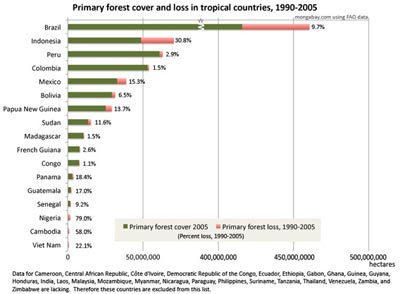
Deforestation Will Affect Agriculture And Global Warming

In the article, "Deforestation Facts, Deforestation Information, Effects of Deforestation" by National Geographic, deforestation is talked about and the impacts it can have on society.

Deforestation has increased exponentially over the years, and we are losing more and more forests around the world as every second passes.

Not only will there be devastating affects on plants and animals in the areas of deforestation, which are 70% of the animals in the world), but it also affects agriculture and the ever increasing temperature of the world.

The trees that are being cut down can no longer provide shade to the rich soil that lays underneath it, thereby drying out the land. The trees also help cycle water throughout the atmosphere, and with these two major issues, much land will no longer be suitable for agriculture. Also, with the loss of forests means the loss of a constant climate. This will lead to extreme temperature changes which will be detrimental to the plants and animals living within it.

Trees are a large part of absorbing the green house gasses, and if they are continuously going to be destroyed, global warming will also occur at a much more rapid rate. The effects of global warming was talked about in a previous blog post

Since deforestation will likely not be affected at an individual level, what policy could be implemented to reduce the rate of deforestation?
Mongabay.com

http://environment.nationalgeographic.com/environment/global-warming/deforestation-overview/